
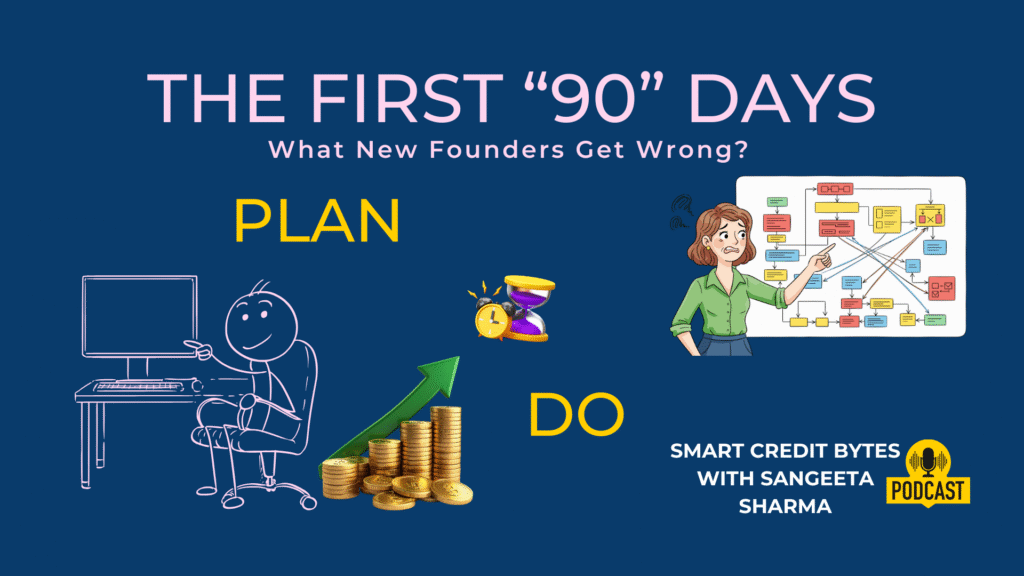
Everyone talks about the dream i.e. being your own boss, building something meaningful, creating freedom. But nobody talks about what actually happens in those first three months. The messy, confusing reality where most of your assumptions get shattered. After spending years analyzing hundreds of business launches, I’ve noticed something: The first 90 days don’t build your business. They reveal what business you’re actually in. And most founders completely miss this. Let me explain you the patterns I keep seeing the ones that separate businesses that survive from those that don’t.
The Logo Trap (Or Why You’re Wasting Your First Month)
Here’s where most new founders start: They spend weeks designing the perfect logo. Picking just the right shade of blue. Building a website with all the modern bells and whistles, getting business cards printed and setting up that professional email address. They’re building the costume of a business instead of the substance of one. I watched a designer who was incredibly talented guy, he spent eight full weeks creating his portfolio website, custom animations, elaborate case studies, sophisticated filtering systems. It was genuinely impressive.
And how did he get his first client? It came through a friend’s referral. Never even looked at the website. Hired him based on a phone call and two samples sent over email. Eight weeks of work. Zero impact on getting that first client. Here’s what’s psychologically interesting about this: Building a website feels productive. It feels like you’re making progress. And it’s safe you can’t get rejected by a logo design. But the market doesn’t care about your branding yet. The market cares about one thing: Can you solve my problem reliably? Every hour you spend perfecting your external image is an hour you’re not spending on the only thing that actually matters in month one that is finding someone who will pay you to solve their problem.
Your First Customer Isn’t Validation; It’s a Mirror
Most business advice tells you to “validate your idea” or “test product-market fit.” Like it’s a research project. But here’s what your first customer actually does: They show you the gap between what you assumed and what’s real. And that gap? It’s always bigger than you think. Let me tell you about Neha. She started a bookkeeping service with this comprehensive vision: financial strategy, growth advising, QuickBooks training, tax preparation support; very sophisticated and very complete. Her first client was a freelance photographer who basically said: “I have shoeboxes full of receipts. I’m terrified of the IRS. I don’t understand any of this. Can you just make it less scary?” Now Neha could have tried to upsell this person. Explained why they needed financial strategy and growth plans. Convinced them they needed the full package. Instead, she listened. She organized the shoeboxes. Set up a simple system and explained everything in plain language to the client and she discovered something crucial: There was an entire segment of creative professionals like photographers, designers, writers who didn’t want a strategic CFO. They wanted someone to translate financial complexity into something manageable. Someone to make the scary parts less overwhelming. That’s a completely different business than she’d planned. Less prestigious, maybe but more needed, more viable and more aligned with what the market actually wanted.
Your first customer tells you what business you’re actually in. Not what business you thought you’d be in. But here’s the hard part: You have to be willing to listen. You have to care more about solving their actual problem than about executing your perfect vision.
The Planning Trap That Kills Flexibility
Let’s talk about something counterintuitive part : Planning is both essential and dangerous. There’s a specific type of person who struggles most in the first 90 days. They’re smart and usually well-educated. They’re used to environments where preparation equals success school, corporate jobs, wherever. So when they start a business, they do what’s always worked: They prepare. Exhaustively. They read every book, take courses and make detailed business plans with three-year financial projections. Research their market until they could teach a university course on it. And then they launch & nothing works the way they planned.
Here’s what’s happening psychologically: The more time you invest in a plan, the more attached you become to it. It stops being a hypothesis you’re testing. It becomes part of your identity that you need to defend. So when the market tells you something different, you don’t adapt you explain why the market is wrong.
I’ve seen founders with 40-page business plans throw them out within two weeks of launching. Every assumption was wrong. The people they thought would buy didn’t. The people who did buy cared about completely different things. Compare that to founders who spend maybe a week doing basic research, then just start making offers. After four months, they’ve had four months of market feedback. They’ve talked to hundreds of potential customers. They’ve seen what works and what doesn’t. They’ve iterated their entire business model based on reality, not theory.
Here’s the principle: Plan enough to start, but not so much that you become attached to the plan. In your first 90 days, treat your business model like a hypothesis, not a blueprint. “I think this might work, let’s find out” instead of “This is how it will work, now I need to execute.” The businesses that thrive have what I call “strong opinions, weakly held.” Clear direction, loose grip. Ready to pivot when reality demands it.
The Money Conversation Nobody Wants to Have
We need to talk about something deeper than tactics: Your relationship with money in these first 90 days shapes everything that comes after. I see two opposite mistakes constantly, and they both come from the same place discomfort with the exchange of value for money.
Mistake one: Underpricing.
Someone starts a business because they care about the work, not because they want to “chase money.” So when it comes time to set prices, they look at competitors and think, “I’ll charge less to be accessible.” Or “I’m new, I need to earn the right to charge real prices.”
Three months later, they’re working 60-hour weeks and can barely pay rent. Here’s what you need to understand: Your discomfort with charging real money isn’t humility. It’s self-sabotage disguised as virtue. When you undercharge, you’re not just hurting yourself. You’re hurting your clients too. Because when you’re barely surviving, you’re stressed. You’re resentful. You can’t afford good tools. You can’t afford to take time to recharge. You can’t afford to turn down wrong-fit clients because you need every rupee.
All of that affects your work quality. It affects whether you’ll still be around in a year to help anyone. Plus, low prices signal something to the market: that your work isn’t that valuable. You attract clients who are cost-shopping, not value-seeking. And those clients? They cancel more. They’re more demanding. They don’t implement your advice. They don’t refer others.
Mistake two: Overspending before validation.
The opposite trap: Some founders immediately spend like they’re a funded startup. Office space. Equipment. Software. Contractors. Before they’ve made a single dollar. They tell themselves, “You have to spend money to make money” or “I’m investing in the business.” But every rupee you commit to fixed costs before you know what works? That’s a bet on assumptions you haven’t tested. And most of those bets will be wrong.
I watched someone rent a retail space in month one. Beautiful location. Year-long lease. Then realized three months in that most of their business was going to come from online sales, not foot traffic. They were stuck paying rent on an empty store for nine more months.
Here’s the framework for your first 90 days:
Charge like you’re established, even if you’re not. You can offer a modest “new business” discount maybe 20-25% off market rate. But you’re establishing that your work has real value.
Spend like you’re broke, even if you’re not. Every rupee that leaves your account should be absolutely necessary to serve customers you actually have. Not potential customers. Not future customers. Actual ones.
The Only Three Systems That Matter
Let me tell you about Marcus. Smart guy, started a marketing agency. Month one, he dropped maybe $2,000 on software. Project management tools, CRM, email platforms, social media schedulers, time tracking, invoicing systems, analytics dashboards. Month three? He was using about 10% of what he’d paid for and the rest was just expensive digital clutter. He had three clients. He needed a notebook and a spreadsheet. Instead, he had enterprise software for a business that didn’t exist yet.
Here’s the truth: In your first 90 days, you need exactly three systems. Just three.
System one: Know where your money is.
A simple spreadsheet. Two columns. Money in, money out. Date, amount, what it was for. You need to look at one thing and answer: “Am I making money or losing money right now?” I’ve met founders in their first 90 days who couldn’t answer that question. They were “busy.” They were “growing.” But they had no idea if they were actually profitable.
System two: Remember what people told you.
When someone reaches out, capture it: Who are they? What do they need? When did you last talk? What’s the next step? Google Sheet, Notion, index cards doesn’t matter. Just capture it somewhere outside your brain. Because in the chaos of starting, you will forget to follow up. And every forgotten follow-up is lost revenue.
System three: Do the same thing every time.
Whatever your service is, document the process. A checklist. A sequence. Something that ensures consistent quality even when you’re stressed and rushed. A home inspector I know made a 47-item checklist. Same order every time. Suddenly his quality was rock solid. Customers loved the consistency. He knew exactly how long each job would take. He could train someone else because the process was documented. That checklist took him maybe an hour to create. Changed his entire business.
Those are your three systems. Everything else the fancy software, the automation, the tools that promise to “scale your business” that’s for later. That’s for when you have a business worth scaling.
Learning Velocity: The Secret Advantage
Here’s what separates businesses that make it from those that don’t: learning velocity. It’s not about having the best idea. It’s not about the most funding. It’s not even about talent. It’s about how fast you can go from “I wonder if this works” to “I know whether this works.”
Imagine two people starting similar businesses.
Person A spends two weeks planning their marketing. Researching best practices. Designing the perfect email sequence. Creating a month of content in advance. Then they launch it all at once and wait for results.
Person B spends two hours writing a basic message. Sends it to ten people. Sees what happens. Adjusts based on responses. Tries again the next day with lessons applied.
After two weeks, Person A has sent one perfectly crafted campaign. They’re waiting for data. Person B has run 14 small experiments. They know what language resonates. What calls-to-action work. What timing gets responses. They’ve iterated 14 times.
Who knows more about their market?
This is learning velocity. Not about perfection. About iteration speed.
The businesses that survive complete learning cycles faster. Test → Learn → Adjust → Repeat. The faster you complete this cycle, the faster you find what works.
Here’s the practice: At the end of every day, write down three things. What worked today? What didn’t work? What will I test differently tomorrow Just a few sentences. Nothing formal. After 90 days, you’ll have a document full of real market intelligence. And you’ll see patterns. What consistently works. What you need to stop doing. This is how you go from having a business idea to having a business. Through rapid cycles of testing, learning, and adapting.
The Reality Nobody Mentions
Your first 90 days are going to be hard emotionally. There’s this romantic idea of entrepreneurship. Freedom, passion, being your own boss. And sure, those things can be true; eventually. But in the first 90 days? You’re going to doubt yourself constantly. You’re going to feel like an impostor. You’re going to wonder if you made a huge mistake. People will say no, people will ghost you, people will not show up and may be they complain. And because it’s your business, your baby, your idea it’s going to feel personal. Here’s what I want you to know: That’s normal. That’s not a sign you’re failing. That’s just what the beginning feels like. Every successful business owner went through this. They just don’t talk about it much once they’ve made it.
So give yourself permission to struggle. Permission to not have it figured out. Permission to feel scared and do it anyway. The businesses that make it past those first 90 days aren’t run by fearless people. They’re run by people who are terrified but keep showing up anyway.
What This All Means
Your first 90 days aren’t about building the perfect business. They’re about discovering what business you’re actually in.
You do that by:
- Maximizing market contact, not perfecting preparations
- Treating your first customers as diagnostic tools, not just validation
- Holding plans loosely and iterating quickly
- Pricing for sustainability and spending only what’s necessary
- Building only the systems you actually need
- Moving fast because learning velocity is your competitive advantage
The businesses that survive aren’t the ones with perfect plans. They’re the ones that adapt fastest to what the market actually wants. So if you’re in your first 90 days right now, or about to be: Give yourself permission to be messy. Permission to be wrong. Permission to pivot. But don’t give yourself permission to hide behind planning and preparation. The market will teach you everything you need to know. But only if you show up and ask.
Want to go more into these patterns? Listen to the full audio episode here on Smart Credit Bytes podcast where we tell the real patterns of business success and failure, one bite at a time.
Got questions about your first 90 days? Drop a comment below. Let’s talk about it.
FREQUENTLY ASKED QUESTIONS
Q1: How do I know if I’m ready to launch my business?
A: You’re ready when you can articulate one specific problem you solve for one specific type of person. That’s it. You don’t need a perfect website, a complete business plan, or all the answers. Launch with the minimum viable offering you can refine everything else based on real customer feedback. Waiting until you feel “completely ready” is just fear disguised as preparation.
Q2: What if I can’t afford to charge market rates as a new business owner?
A: This is backwards thinking. You can’t afford NOT to charge market rates. Underpricing doesn’t just hurt your income it attracts the wrong clients, creates unsustainable workloads, and signals low value to the market. Instead, charge 20-25% below established competitors if you must offer a discount, but never 50% or more. Remember: your pricing trains customers how to value you.
Q3: Should I quit my job before starting my business?
A: Not necessarily. Many successful businesses start as side projects while you’re still employed. This gives you financial stability to make better decisions and reduces desperate “I need money now” pricing. However, if your job contract prohibits side businesses or if you need full-time focus to launch, that’s different. The key is having enough runway (savings) to survive your first 6-12 months without revenue panic.
Q4: How much money should I save before starting?
A: Aim for 3-6 months of personal living expenses at minimum. This gives you breathing room to focus on building rather than surviving. But remember: the goal isn’t to spend that money on business expenses. It’s your safety net for personal bills while you keep business costs near zero and focus on generating revenue quickly.
Q5: What if my first customer wants something completely different from what I planned to offer?
A: Listen to them. Seriously. This is the market telling you what it actually needs versus what you assumed it needed. The most successful businesses are built on paying attention to these early signals. Your first customer is diagnosing the real market need—don’t ignore that data just because it doesn’t match your original vision.
Q6: How do I find my first customer when I have no reputation or portfolio?
A: Start with warm networks: former colleagues, friends, family, online communities you’re part of. Offer a limited-time “founding client” discount (20-25% off) in exchange for honest feedback and a testimonial. Be direct: “I’m launching X service and looking for 3-5 founding clients. Here’s what I’m offering.” Personal outreach beats passive waiting every time.
Q7: Is it okay to pivot completely from my original business idea?
A: Absolutely. In fact, most successful businesses look nothing like the original plan. Pivoting based on market feedback isn’t failure—it’s intelligence. The goal isn’t to execute your original idea perfectly; it’s to build something the market actually wants. Stay flexible in your first 90 days.
Q8: What if I’m a perfectionist and struggle with “good enough”?
A: Understand that perfectionism in the first 90 days is actually self-sabotage. It’s fear hiding behind high standards. The market doesn’t need perfect—it needs helpful. Launch with “good enough to solve the problem” and improve based on feedback. Remember: a imperfect product in customers’ hands beats a perfect product in your head.
Q9: Should I incorporate/register my LLC before getting my first customer?
A: Not necessarily. In many places, you can operate as a sole proprietor initially and formalize later. Check your local laws, but don’t let paperwork delay market contact. You can always register your business after you’ve validated that people will actually pay you. Legal structure is important—just not more important than proving your business model works.
Q10: How do I balance my time between marketing and delivering service?
A: In your first 90 days, aim for 60% customer acquisition activities (marketing, outreach, networking) and 40% delivery. As you get busier, this might flip temporarily, but always reserve time for future pipeline. The mistake new founders make is going 100% delivery mode when they get customers, then having zero pipeline when those projects end.
Q11: What’s the biggest mistake I can make in my first 90 days?
A: Hiding behind preparation instead of engaging with the market. Whether it’s “perfecting” your website, endlessly researching, taking more courses, or waiting to feel “ready” these are all ways to avoid the vulnerability of actually offering your services and potentially being rejected. The market contact is where real learning happens.
Q12: How do I know if I should keep going or shut down after 90 days?
A: Ask yourself: Have I genuinely tested my offering with the market? Have I had at least 50 meaningful conversations with potential customers? Have I made clear offers to at least 20 people? If no, you haven’t really tested yet you’ve just been preparing. If yes and there’s still no traction, then you have real data that the market doesn’t want what you’re offering, and pivoting makes sense.
If you want to learn more about money mindset, You can find all 10 books in one place here:
– The Psychology of Money → Link
– Let’s Talk Money → Link
– Rich Dad Poor Dad → Link
– Zero to One → Link
– Financial Intelligence for Entrepreneurs → Link
– The Millionaire Fastlane → Link
– We Should All Be Millionaires → Link
– Think and Grow Rich → Link
– Atomic Habits → Link
– The Almanack of Naval Ravikant → Link
Reading books builds clarity, but growth comes when we apply what we learn every single day. That’s why I created my own Finance & Productivity Journal for people who want to:
- save more consciously
- reduce unnecessary expenses
- build wealthy habits
- plan their goals month-wise
- track gratitude & mindset
If you want to read these books and actually transform your financial life in 2026, this journal will support you every step of the way.
👉 Order your journal here : https://a.co/d/0wiLhnN
Books open the mind.
Journaling rewires it.
Together, they change your reality.
If this helped, follow my WhatsApp Channel “Smart Credit with Sangeeta” for daily business finance insights.